
The third quarter of 2026 saw 155,000 sq ft of office deals signed, a reduction of around 30,000 sq ft compared to Q2 and almost 40,000 sq ft less than in the same three-month period in 2025, according to the Manchester Office Agents Forum.
So far this year, Manchester has recorded 625,000 sq ft of deals, meaning that the last three months of the year will need to produce 375,000 sq ft to break the 1m sq ft barrier and 475,000 sq ft to reach the city’s 1.1m sq ft five-year annual letting average.
Matt Shufflebottom, director at CBRE, said: “There is no hiding from the fact Q3 was a poor performance for the city centre office market and we are behind target to hit our 5-year average of 1.1m sq ft.
“However, positivity should be taken by the number of deals recorded, demonstrating an active market sub 10,000 sq ft, and we expect the larger transactions to return in Q4 to boost year-end figures.”
Research from the Manchester Office Agents Forum found that 50 deals completed in July, August, and September.
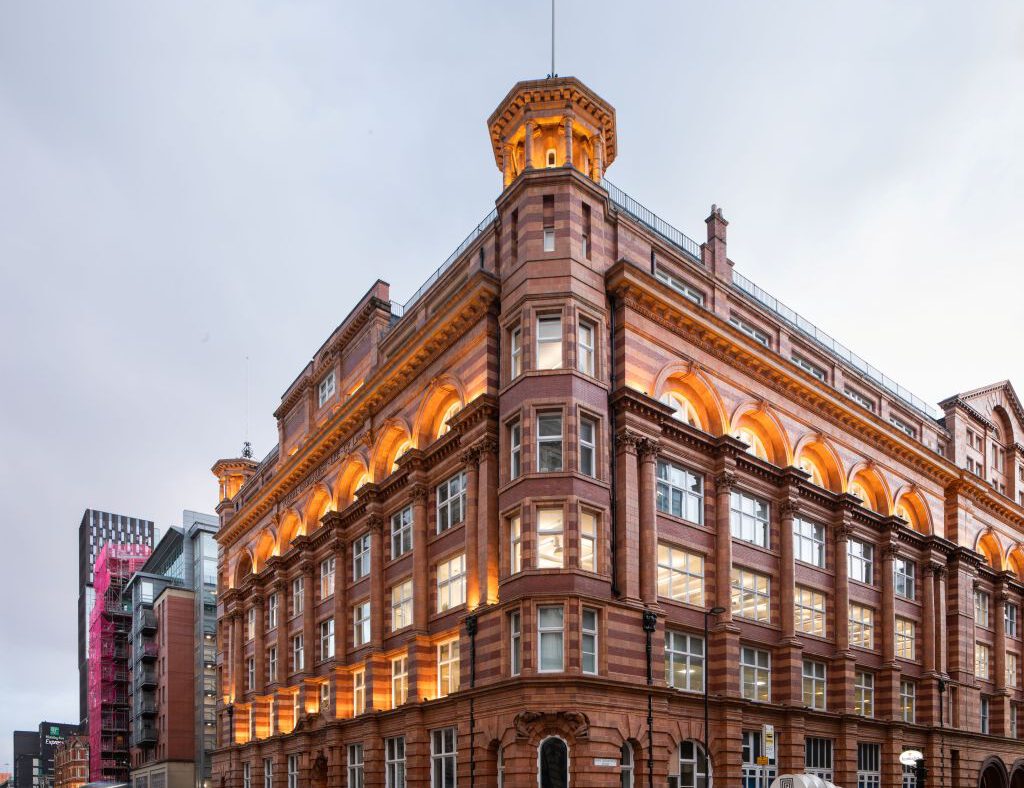
Notable deals in Q3 included Deliveroo’s 25,000 sq ft letting at Tootal Building, Dechra taking 14,000 sq ft at Bruntwood’s No.3 Circle Square and Leanord Curtis signing for 10,000 sq ft at Muse’s Eden.
Despite the slowdown in deals, Shufflebottom is confident there is still strong demand for workspace in Manchester.
“The pace of decision making by occupiers has affected the market, however there are generally good levels of demand and we are therefore confident that take-up will bounce back across Q4 and into 2027,” he said.
Out-of-town office take-up was 182,000 sq ft, made up of 54,000 sq ft in Salford Quays and Old Trafford and 128,000 sq ft in South Manchester.
The quarter saw two notable larger transactions complete: Siemens signed for 36,922 sq ft at Towers Business Park in Didsbury while in Salford Quays, AM London took 31,250 sq ft at Centenary House.
John Nash, director at Canning O’Neill, said: “The out-of-town take-up for the period has been very much in line with the quarterly average over the last five years across both markets, so it’s fair to describe it as a steady and resilient market.
“A number of office buildings are continuing to be repurposed for alternative uses, creating a more balanced market and reducing the volume of secondary stock. As occupiers remain focused on quality, this is providing greater confidence for landlords to invest, refurbish and reposition space to meet evolving occupier requirements.”
MOAF was formed in 2009, and members include Avison Young, Carter Jonas, CBRE, Colliers International, Canning O’Neill, Cushman & Wakefield, Edwards Property Consultants, Fisher German, Hallam Property Consultants, JLL, Knight Frank, LSH, OBI, Savills, TSG, and Sixteen.